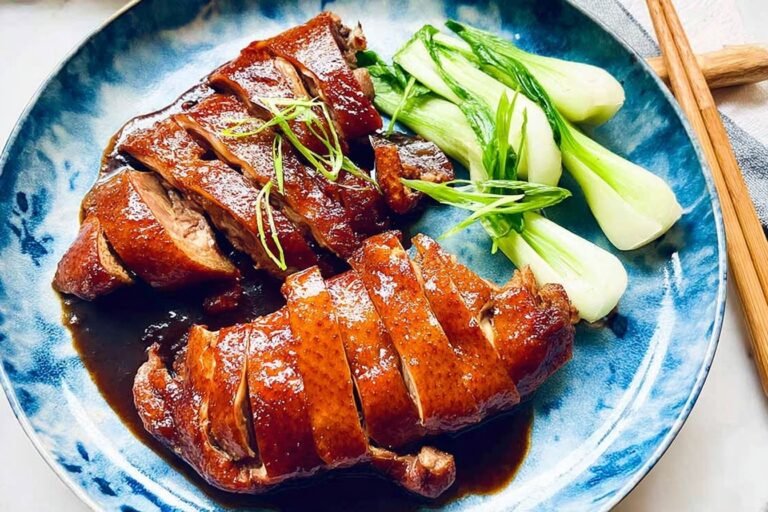
Ingredients
– 1 duckling, about 5-6 pounds (2.5 kg)
– 1½ tablespoons salt
– 2½ teaspoons five-spice powder
– 2 teaspoons sugar
– 1 teaspoon sand ginger powder or galangal powder
– 2 tablespoons Shaoxing wine
– 2 tablespoons chee hou sauce
– 2 tablespoons warm water
– 1 tablespoon ground bean sauce
– 1 tablespoon hoisin sauce
– 1 tablespoon oyster sauce
– 1 tablespoon red fermented bean curd (mix of solids and liquid)
– 2 teaspoons neutral oil (vegetable, canola, peanut, or avocado oil)
– 2 slices ginger (⅛-inch/3mm thick)
– 2 medium garlic cloves, sliced
– 1 scallion (white and green parts cut into 2-inch/5 cm pieces and smashed)
– 2 bay leaves
– 2 star anise segments
– 1 cinnamon stick, about 3 inches/7-8 cm broken into small pieces
– 1 piece orange peel, 2 inches/5 cm, broken into a few small pieces
– 6 cups water
– 3 tablespoons red vinegar
– 2 tablespoons maltose or corn syrup
– 1½ teaspoons salt
– ½ cup hot water for the roasting pan
Instructions
1-First Step: Prepare and Clean the Duck Start by trimming excess fat from the duck cavity. Remove wing tips and feet if your duck came whole. Leave the neck attached for roasting and inflation, as this makes the skin separation process much easier. Remove any pinfeathers with tweezers, take out the internal organs (save the liver for another use if you like), and rinse the duck thoroughly inside and out. Pat it completely dry with paper towels.
2-Second Step: Season the Cavity Mix the salt, five-spice powder, sugar, and sand ginger powder in a small bowl. Rub the duck cavity thoroughly with the Shaoxing wine first, then coat it evenly with your spice mixture. Make sure to get the seasoning into every nook and cranny of the cavity. Place the duck on a wire rack over a baking sheet and refrigerate it uncovered for 1 hour.
3-Third Step: Prepare the Cooked Marinade While the duck chills, combine the chee hou sauce, warm water, ground bean sauce, hoisin sauce, oyster sauce, and red fermented bean curd in a bowl. In a small saucepan, heat the neutral oil over medium-low heat. Add the ginger slices and cook until fragrant, about 30 seconds. Add the garlic, scallion, bay leaves, star anise, cinnamon pieces, and orange peel, cooking briefly for another 30 seconds while stirring constantly. Pour in your sauce mixture and bring it to a gentle simmer. Stir often and cook for about 2-3 minutes until the flavors meld together. Remove from heat and let it cool completely before using.
4-Fourth Step: Marinate and Seal the Duck After the duck has chilled for 1 hour, pour the cooled marinade into the cavity. Rotate the duck to coat the inside evenly, being careful to keep the outside skin clean and dry. Now comes the crucial sealing step: weave a metal skewer through the skin flaps at the tail end to seal the cavity airtight. You can alternatively use butcher’s twine tied very tightly. This seal is essential for keeping the marinade inside during roasting.
5-Fifth Step: Inflate the Skin Here’s the secret technique that separates good Chinese roast duck from great: carefully insert the tube from an electric air pump under the neck skin, between the skin and the meat. Pump air gently until the skin separates fully from the meat, like inflating a balloon. This step ensures even browning and maximum crispiness. Once inflated, immediately seal the neck opening with kitchen string while maintaining the air pressure inside. Work quickly but carefully to avoid tearing the delicate skin.
6-Sixth Step: Apply the Hot Water Bath Place your duck on a wire rack over a roasting pan. Ladle hot water evenly over the entire duck, then flip it over and repeat on the other side. This step tightens the skin and begins the rendering process. Set the duck aside and discard the water from the pan.
7-Seventh Step: Apply the Vinegar Bath Heat 2 cups of water with the red vinegar, maltose (or corn syrup), and 1½ teaspoons salt until the salt completely dissolves. Ladle this hot vinegar mixture over the duck, starting with the breast side down. Flip and repeat with the breast side up. This vinegar bath gives the duck its signature deep color and glossy finish.
8-Eighth Step: Air-Dry Overnight Let the duck air-dry at room temperature for 30 minutes after the vinegar bath. Then place it back on your sheet pan, breast side down, and refrigerate it uncovered overnight. This drying period is absolutely critical for achieving crispy skin, so resist any temptation to skip or shorten it.
9-Ninth Step: Roast to Perfection Four hours before you plan to serve, remove the duck from the refrigerator and let it come to room temperature on the counter for 2 hours. Preheat your oven to 350°F (175°C). Place ½ cup hot water in the roasting pan. Roast the duck breast side down for 25 minutes, then rotate the pan 180 degrees and roast for another 25 minutes. Flip the duck breast side up and roast for 20 minutes, rotate the pan 180 degrees again, and roast for a final 20 minutes. The total roasting time is about 1 hour 30 minutes. Remove the duck from the oven and tent it loosely with foil. Let it rest for 20 minutes before carving.
10-Final Step: Carve and Serve Remove the skewer sealing the cavity. Pour the fat and juices through a fine strainer into a bowl and reserve the fat for another use. To carve, halve the duck lengthwise, remove the backbone, separate the wings and leg quarters, then chop the remaining meat into bite-sized pieces. Serve immediately with the reserved pan sauce.
Last Step:
Please leave a rating and comment letting us know how you liked this recipe! This helps our business to thrive and continue providing free, high-quality recipes for you.Notes
🦆 Choose the plumpest duck for the best meat yield.
🫁 Use an electric air pump and plastic tubing to inflate the skin away from the meat for even roasting.
❄️ Air-dry the duck uncovered overnight to ensure perfectly crispy skin.
- Prep Time: 2 hours
- Marinate and Air-Dry: Overnight
- Cook Time: 1 hour 30 minutes
- Category: Poultry
- Method: Roasting
- Cuisine: Chinese
Nutrition
- Serving Size: 1 serving
- Calories: 455 kcal
- Sugar: 4 g
- Sodium: 2752 mg
- Fat: 23 g
- Saturated Fat: 6 g
- Unsaturated Fat: 15 g
- Trans Fat: 0.01 g
- Carbohydrates: 8 g
- Fiber: 1 g
- Protein: 50 g
- Cholesterol: 208 mg